

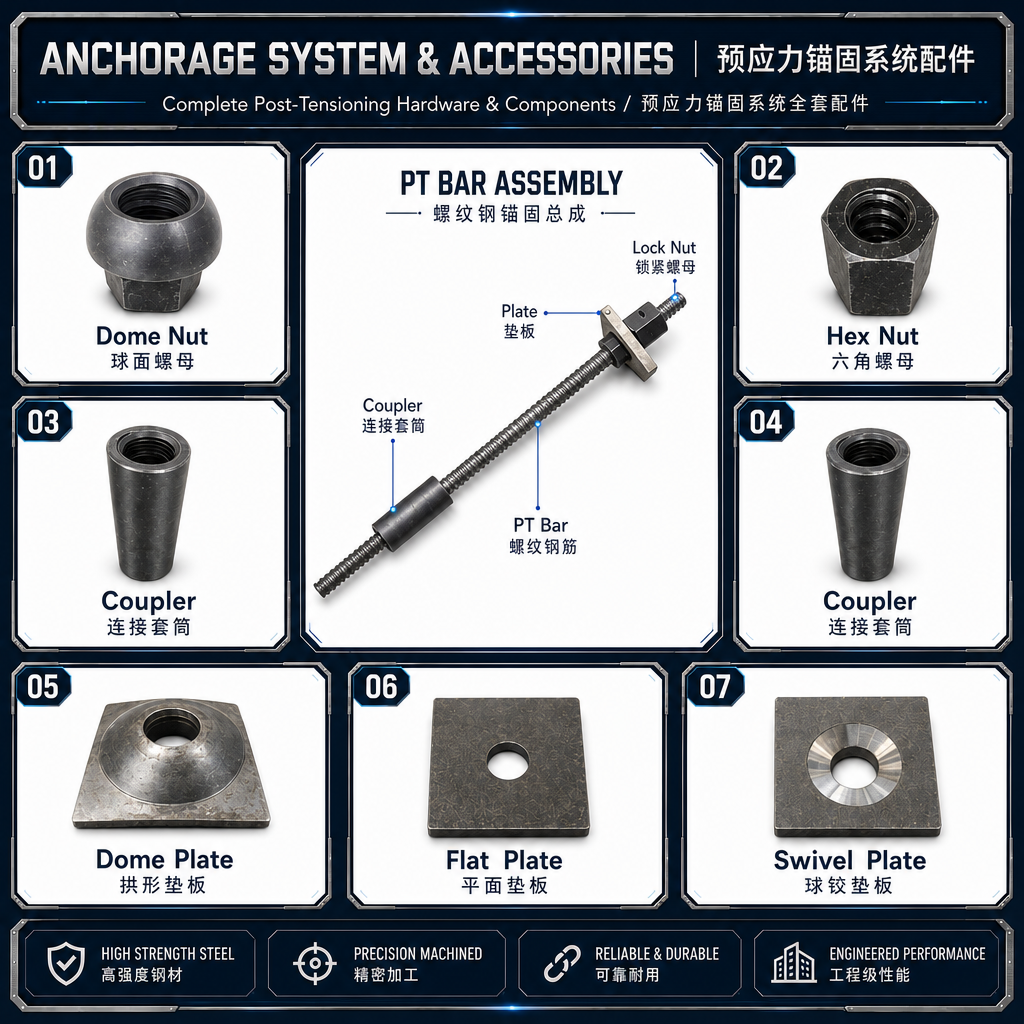
— Dateline — On the main pylon of the south navigation channel of the Zhangjinggao Yangtze River Bridge, batches of 40 mm high-strength threaded bars are being used for form-traveler anchorage and temporary fixation. At almost the same moment, on a gigawatt-scale wind farm in northwest China, bars of the same specification are being threaded through anchor plates inside turbine foundations and stressed, clamping the tower firmly against its concrete pedestal. Two scenes that appear to have nothing in common are, in fact, using the same product: the post-tensioning bar.
For decades this product has been filed away under an upstream category label — “prestressing material” — with far less public recognition than structural steelwork, curtain walling, or even concrete admixtures. Over the past three years, however, the boundaries of where it is used have been widening fast.
What problem does it actually solve?
Concrete is strong in compression and weak in tension. That is a built-in defect, not a design error. The logic of a post-tensioning bar is to wait until the concrete has been cast and gained strength, then actively stretch a high-strength steel bar with a hydraulic jack and lock that force into the member through an anchorage — putting the concrete into a state of pre-compression. When external loading later introduces tensile stress, that pre-compression must first be overcome before the member can crack.
This is the fundamental difference between “passive reinforcement” and “active pre-stressing,” and it is what separates a PT bar from ordinary rebar (HRB400/500). Ordinary rebar is a skeleton; a PT bar is a tool for applying force. Yield strengths across the GB/T 20065 series run from 500 MPa to 1,200 MPa, whereas conventional reinforcing bar sits mostly in the 400–500 MPa range and is not permitted to carry stressing forces at all.
The resulting engineering gains are quantifiable. Structures using post-tensioning can cut concrete consumption by roughly 20% and steel consumption by roughly 25% compared with conventional reinforced concrete (third-party market research estimate). The larger prize is span and space: unbonded post-tensioned slabs allow wider column grids and shallower floor depths, giving commercial complexes and supertall towers far more usable, column-free area.
Six tracks — and they are not equally warm
1. Bridges — still the largest traditional base. Cantilever casting form-traveler anchorage, top-slab tendons in continuous beams and continuous rigid frames, anchorage zones in cable-stayed pylons, deviators for external prestressing, bearing anchorage: there is barely a stage where it is absent. China’s Ministry of Transport reports transportation fixed-asset investment of RMB 2.4 trillion in the first three quarters of 2026. The Shiziyang Link has topped out its main pylon; the Zhangjinggao Yangtze River Bridge is more than 60% complete; the Haitai River Crossing has driven its right-line shield past the halfway mark; the Xiamen section of the Xiamen–Kinmen Bridge has over 90% of its marine mainline connected. What these projects share is that they are pushing span records and construction difficulty simultaneously — and span is precisely the variable that multiplies the value of prestressing material per structure.
2. Supertall towers and long-span public buildings. Transfer beams, thick rafts, long-span floor systems, and vertical prestressing in core shear walls are the classic territory of PSB830 and above. Vertical tendons control lateral deformation under wind and seismic action and are close to standard equipment in structures above 300 metres.
3. Railways, tunnels and slopes. Ballastless track anchorage, tunnel surrounding-rock reinforcement, anti-slide piles and prestressed rock anchors on high slopes make up the invisible volume behind rail transit and mountain expressways. This segment is dominated by mid-strength PSB785 / PSB830 — high tonnage, price sensitive.
4. Hydraulics, nuclear and LNG. Dam strengthening, lock chambers, hoop prestressing in nuclear containment, and external-tank prestressing for full-containment LNG tanks represent the most demanding applications in terms of fatigue performance and stress relaxation, and are typically supplied by the handful of manufacturers with nuclear-sector track records. Large diameters — 36 mm, 40 mm, 50 mm and 63.5 mm — serve this field above all.
5. New energy — the fastest-growing line. China’s National Energy Administration reports that as of end-September 2026, installed wind capacity reached 700 GW, up 20.4% year on year, with combined wind and solar capacity passing 2.01 billion kW. The Chinese Wind Energy Association has forecast around 120 GW of new wind installations in China for 2026. Turbines above 2 MW have largely replaced the traditional embedded foundation ring with prestressed anchor-bolt assemblies, making foundation anchorage one of the most predictable growth pools for PT bars.
6. Strengthening existing structures — an old track being rediscovered. Through 2026, public tenders for post-tensioned bridge strengthening have appeared in quick succession: Whangarei and Far North district councils in New Zealand, deck post-tensioning on Yanco Creek Bridge in Australia, a 30 m post-tensioned beam combined with rock anchor procurement by Thailand’s Department of Highways, and PSC slab replacement on Indian Railways. Stock of ageing bridges is being released as demand globally at the same time. China is no exception: large numbers of highway bridges built in the 1990s and 2000s are entering the back half of their design service life, and “strengthening” is replacing “new build” as a major destination for prestressing material.
The fact that is changing
Applications used to be segmented by project type. They are now being re-segmented by the ratio of stock to new build. Volume from new bridges and new wind farms is still rising, but the share from strengthening, retrofitting and in-service replacement is rising faster. For bar producers this changes the sales logic: from “follow the project” to “follow the asset lifecycle.” The latter is more stable — but it demands certification, testing, rapid delivery and field technical capability, not just tonnage and price.
Post time: Oct-29-2026